Why Are Social Media Influencers Important?

The term “social media influencers” is one thrown around a lot lately. But who are they?

Over 3.484 billion people actively use social media, making it an ideal scene for engagement and business. This is where influencers come into the picture.

Influencers “are people who have built a reputation for their knowledge and expertise on a specific topic.” They create content on their preferred social media channels and create large followings of engaged people who pay close attention to their platform.

There are different layers to being an influencer. They must consider which social media platforms to utilize to gather an audience and the best ways with which to engage with that audience. It is common to see that most influencers have a story to tell or cause to advocate for.

One way in which influencers create their following is by being open about their life or products used. They create posts informing others about what is going on in their world. What do they have planned today? What meetings will they be attending? 

As an influencer grows their base to an extent large enough, they are able to attract partnerships with brands. When brands look for an individual or entity to represent them, they often look for someone relevant to the product/service they are offering. One of the goals in an influencer/brand partnership is for the influencer to expose the product/service to a new and larger audience, establishing a sense of trust and legitimacy. 

Influencers have a connection with their audience that most companies do not have. They can engage with their following in a personal way by liking and replying to comments. While there are multiple ways for influencers to interact with their following, they have to practice consistency.

Additionally, influencers are classified according to how many followers they have. 

Nano-influencers are those who have fewer than 1,000 followers on social media. 

A micro-influencer is one with 1,000-40,000 followers on social media, while a macro-influencer might have a range of 40,000 to 1 million followers. 

Then, there are the mega-influencers, who have more than 1 million followers. In this category, we find celebrities, but we also have those who have gained their followings via other online or social activities. For example, David Dobrik (a popular vlogger), and Emma Chamberlain (a popular vlogger and fashion guru) are well-known mega-influencers. 

According to Hootsuite, “more than two-thirds (67.9%) of U.S marketers will use some form of influencer marketing this year,” a number that is “expected to increase to 72.5% in 2022.”

Additionally, Civic Science found that 14% of 18-to-24-year-olds and 11% of millennials had bought something within the last six months because a blogger or influencer recommended it.

As the world becomes more interconnected with social media, influencer marketing doesn’t appear to be going anywhere. While there is no one-size-fits all approach to creating a partnership with an influencer, there are multiple options and benefits in doing so for many businesses. 


Author: Madison Goudeaux, Envie Media Intern

TikTok: A Guide to the Fastest-Growing Social Media App

Hundreds of millions of viewers have flocked to the video-sharing social network, TikTok. So what exactly is TikTok and is it right for your social media marketing purposes?

TikTok evolved from its beginning as the app Musical.ly in 2014 and became what we now know it as in 2018. The algorithm anticipates what type of content users will enjoy based on what they have previously viewed and/or interacted with.

Users can create a variety of personalized short videos with a duration of 15 seconds to one minute. Music is often featured in the background and videos can be sped up or slowed down.

The app also features editing effects such as filters, animations, and templates.Content can be uploaded to the app or filmed within it. Viewers can like, comment on, or share the videos they enjoy. 

The app has continued to grow in popularity. Here are a few statistics about the platform:

-In 2020, TikTok was the most downloaded app.

-TikTok ranks as the 7th most used social platform in the world. (Facebook, YouTube, Instagram, WhatsApp, Messenger, and WeChat outranked the app.)

-The majority of TikTok users in the U.S. are below 30 years old.

With TikTok, you only have 100 characters, so the majority of your message will be expressed via the video.

Exploring the App:

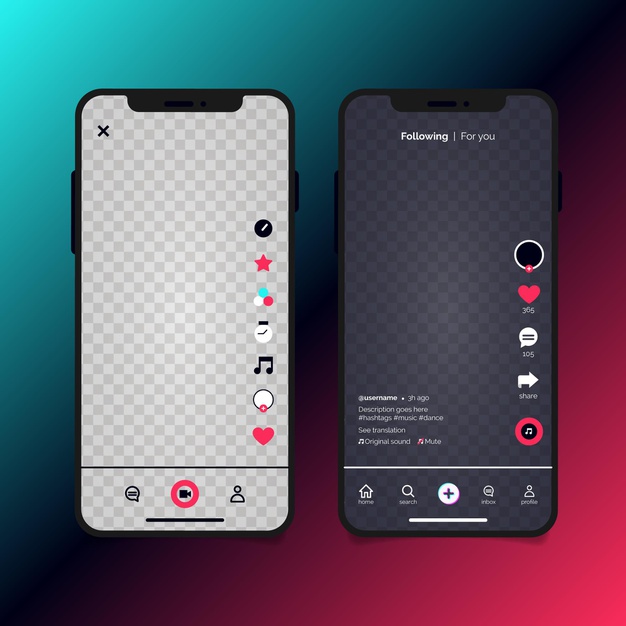
When you click on the app, it will take you to the Home page. 

Here you will find Following | For You. You can toggle between the two options. 

For You: a feed consisting of videos recommended to you based on your interests/activity on the app (ex: if you like dog videos, the For You will curate dog videos for you to watch)

Following: content from users you follow will show up here 

The Discover/Search page displays trending hashtags and effects.

The + page is where you can upload or create content. Here, you can play with speed settings, filters, effects, and templates. You can also go LIVE via the app.

The Inbox is where you can read your comments and see who liked your content. 

The Me/Profile page allows you to see your profile. 

TikTok feeds on viral trends and is a different beast than other social media platforms. A variety of content is shared on the app. From art, food, DIY, fashion, life hacks, etc., name it and you can find it. Within these niches, community is often developed. 

TikTok Tips:

-Create unique content. Embrace who you are and what works for you. (What is special about your business? What is it that only you offer?)

-Pay attention to the trends – they come & go quickly. Be sure to hop on these trends while they’re still trending. You have to be ready to react which means closely monitoring the app. (The Discover page makes this easy.)

-Have fun with it. TikTok users are mostly Gen Z who value authenticity and aren’t looking for perfection. (Be natural & don’t be afraid to mess up.)

-Be innovative. Here is the space to think outside of the box. (The more creative, the better.)


Author: Kara Timberlake, Co-Creator of Envie Media

Talk the Talk to Walk the Walk: Marketing Lingo

Part of navigating the world of social media marketing is learning the lingo. So, we’ve created a glossary of common terminology and acronyms that will help you discuss your social media strategy with ease while looking like a boss.

A/B Testing (also known as split testing): the process of showing two versions (variant A & variant B) of the same webpage to different website visitors and then comparing which version is the most effective (aka drives the most website conversions or captures the most engagement). Marketing is all about experimentation and finding what works for your business goals. Statistical analysis helps us determine what works.

Algorithms: a set of rules designating how a group of data behaves. In regards to social media, algorithms are what determine the placement of content and advertisements (who sees what). Factors such as demographics or a user’s previous behavior are utilized to craft the user’s experience including the products and offers he/she sees. 

Side note: social media algorithms are always changing and differ depending on the platform being used. When you know the rules, you are able to maximize user engagement and ensure the right audience is seeing your content (which can lead to more customers, sales, etc.).

Analytics: the gathering of meaningful patterns in data that assist marketers in understanding & utilizing social media performance and metrics.

First, data is tracked and collected. Next, comes analyzing the data. It’s this data on which marketers/business owners will base their business decisions. What’s garnering attention? What’s working? And just as important, what’s not working? There are a range of tools that can help to break down the info and turn them into insights that will help you improve your marketing efforts and overall strategy.

Audience: the specific group of people you wish to reach.

As we like to call them, “our people.” There’s a lot of social media users out there who may not be the right fit for your specific product or business. The goal is to find people who are the most likely to be interested in what you are offering. Sometimes, this group shares common motivators or characteristics. Knowing who you’re trying to reach helps you determine how you’re going to reach them. 

Brand: a marketing or business concept that is easily distinguishable and helps people identify the specific affiliated company, product, or service.  

This word is tossed around a lot out there, but in a nutshell, a brand is what people think of when they think of your business/what you are offering. The key in developing a brand is to know who you are & to be able to easily boil that down. Branding evokes a visual image (what colors, fonts, etc. are affiliated with your company) but also a feeling.

Engagement: how people are interacting with social media platforms.

Like most things on social media, engagement can be evaluated several ways: likes, favorites, comments, direct messages, shares, saves, mentions, etc. 

It may surprise you, but people are looking for connection on social media. It’s not just about the likes but about the conversations that transpire. Engagement also helps you gauge whether or not the content you’re sharing is resonating with your audience. 

Impressions: how many times your content was viewed.

It is not necessary for someone to click or otherwise engage with a post in order for it to count as an impression. Moreover, one person can have several impressions per post, etc. if they viewed it multiple times.

Reach: the amount of people who view your content.

Unlike impressions, reach is about the number of viewers instead of views. I can view a post 10 times; ergo, I leave 10 impressions, but my reach is still one.

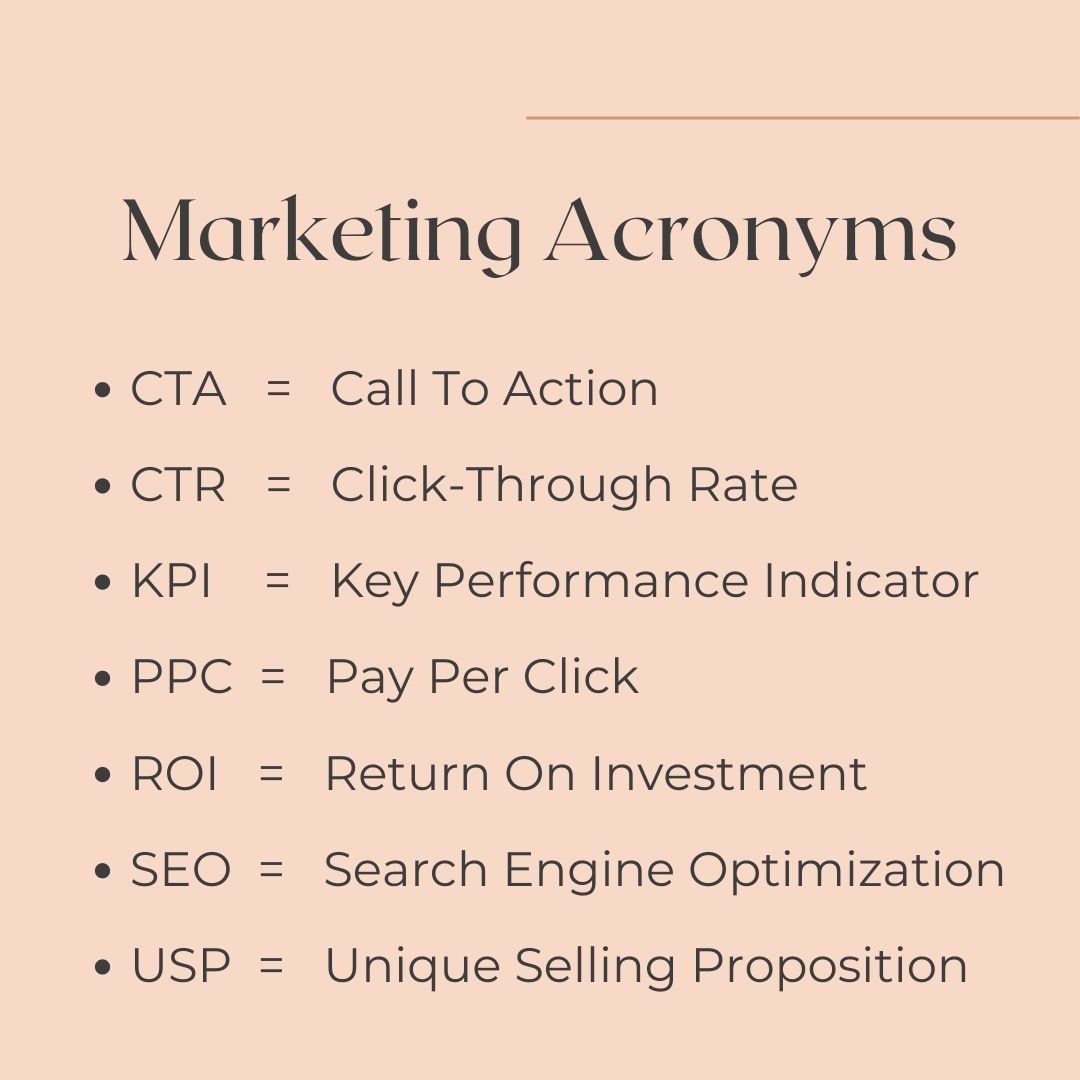
CTA = Call To Action

A CTA is about prompting users/viewers to act in a specific way (encourages customers to buy the product, members to sign up for that newsletter, etc.)

CTR = Click-Through-Rate: ratio of clicks to views.

CTRs help businesses determine the success of their online advertising. (Are people provoked to act (click on the link) or are they merely scrolling on?)

KPI = Key Performance Indicator

A KPI is a set of measurements to assess the performance of an organization, company, etc. (Was my business’s goal achieved? Did I reach my target?)

-PPC = Pay Per Click

This one is just what it sounds – advertisers pay each time their ad is clicked. This is often used to generate traffic to websites.

-ROI = Return On Investment 

ROI is utilized to discover the gains from your social media strategy. Was it worth the investment? Add the value gained and divide it by the investment made to determine your ROI.

-SEO = Search Engine Optimization

Simply put, SEO is the process in which you improve your visibility on search engines. This is done by optimizing the quality of your website and making the content easily discoverable. We wish it was only this simple. SEO can be a complicated beast & requires constant learning.

-USP = Unique Selling Proposition (also unique selling point)

What makes your business different from everyone else’s? What is it that only you offer?


Author: Kara Timberlake, Co-Creator of Envie Media

5 Reasons Social Media is More Important Than Ever

Social media is becoming more vital than ever before with digital marketing ad spend growing while traditional ad spend continues to decrease. There are a lot of reasons that your business should be investing in social media, but we break down five of the most important reasons below.

Social media gives your brand a presence online.

Social media gives your brand space to tell its story no matter your marketing budget. Social sites give you control of your brand’s narrative. You can build brand awareness with organic growth alone or include paid advertising on a budget that works for you.

Social media increases your marketplace awareness.

Social media gives you and your audience channels to stay up-to-date on important marketplace and industry changes. Social media can clue you in to a change in climate for your target audiences.

Social media gives you a direct line of communication with your audience.

Social media gives you an opportunity to build relationships with your customers and stay top of mind when they’re buying. You can build an entire community of dedicated customers just by interacting with them online! Social sites make customer service and communication easier and you can stay on top of your brand sentiment with social listening – helping you learn about what your customers do and don’t like.

Social media can increase both your foot traffic and web traffic.

Whether you’re strictly an e-commerce business or you have a brick-and-mortar storefront, social media can help move your audience to their intended destination and boost sales in the process. You can track this process online with analytics and key performance indicators (KPIs) to ensure your return on investment (ROI).

Social media can help increase your brand’s search engine optimization (SEO).

Social media can help your brand’s Google ranking. The links you share across social sites increase your brand’s exposure and improves your brand’s credibility. Social media sites drive website traffic while you wait for your SEO measures to catch up. Read more about how social media can help your SEO here.

These are just a few of the reasons you should incorporate social media in your marketing mix to achieve your business goals. It’s free, easy to use, and can make a huge impact.

If you have more questions about how to make social media work for your business, comment below and ask us!


Author: Shelby Brannan, Co-Creator of Envie Media

Don’t miss a beat.