Part of navigating the world of social media marketing is learning the lingo. So, we’ve created a glossary of common terminology and acronyms that will help you discuss your social media strategy with ease while looking like a boss.

–A/B Testing (also known as split testing): the process of showing two versions (variant A & variant B) of the same webpage to different website visitors and then comparing which version is the most effective (aka drives the most website conversions or captures the most engagement). Marketing is all about experimentation and finding what works for your business goals. Statistical analysis helps us determine what works.
–Algorithms: a set of rules designating how a group of data behaves. In regards to social media, algorithms are what determine the placement of content and advertisements (who sees what). Factors such as demographics or a user’s previous behavior are utilized to craft the user’s experience including the products and offers he/she sees.
Side note: social media algorithms are always changing and differ depending on the platform being used. When you know the rules, you are able to maximize user engagement and ensure the right audience is seeing your content (which can lead to more customers, sales, etc.).
–Analytics: the gathering of meaningful patterns in data that assist marketers in understanding & utilizing social media performance and metrics.
First, data is tracked and collected. Next, comes analyzing the data. It’s this data on which marketers/business owners will base their business decisions. What’s garnering attention? What’s working? And just as important, what’s not working? There are a range of tools that can help to break down the info and turn them into insights that will help you improve your marketing efforts and overall strategy.
–Audience: the specific group of people you wish to reach.
As we like to call them, “our people.” There’s a lot of social media users out there who may not be the right fit for your specific product or business. The goal is to find people who are the most likely to be interested in what you are offering. Sometimes, this group shares common motivators or characteristics. Knowing who you’re trying to reach helps you determine how you’re going to reach them.
–Brand: a marketing or business concept that is easily distinguishable and helps people identify the specific affiliated company, product, or service.
This word is tossed around a lot out there, but in a nutshell, a brand is what people think of when they think of your business/what you are offering. The key in developing a brand is to know who you are & to be able to easily boil that down. Branding evokes a visual image (what colors, fonts, etc. are affiliated with your company) but also a feeling.
–Engagement: how people are interacting with social media platforms.
Like most things on social media, engagement can be evaluated several ways: likes, favorites, comments, direct messages, shares, saves, mentions, etc.
It may surprise you, but people are looking for connection on social media. It’s not just about the likes but about the conversations that transpire. Engagement also helps you gauge whether or not the content you’re sharing is resonating with your audience.
–Impressions: how many times your content was viewed.
It is not necessary for someone to click or otherwise engage with a post in order for it to count as an impression. Moreover, one person can have several impressions per post, etc. if they viewed it multiple times.
–Reach: the amount of people who view your content.
Unlike impressions, reach is about the number of viewers instead of views. I can view a post 10 times; ergo, I leave 10 impressions, but my reach is still one.
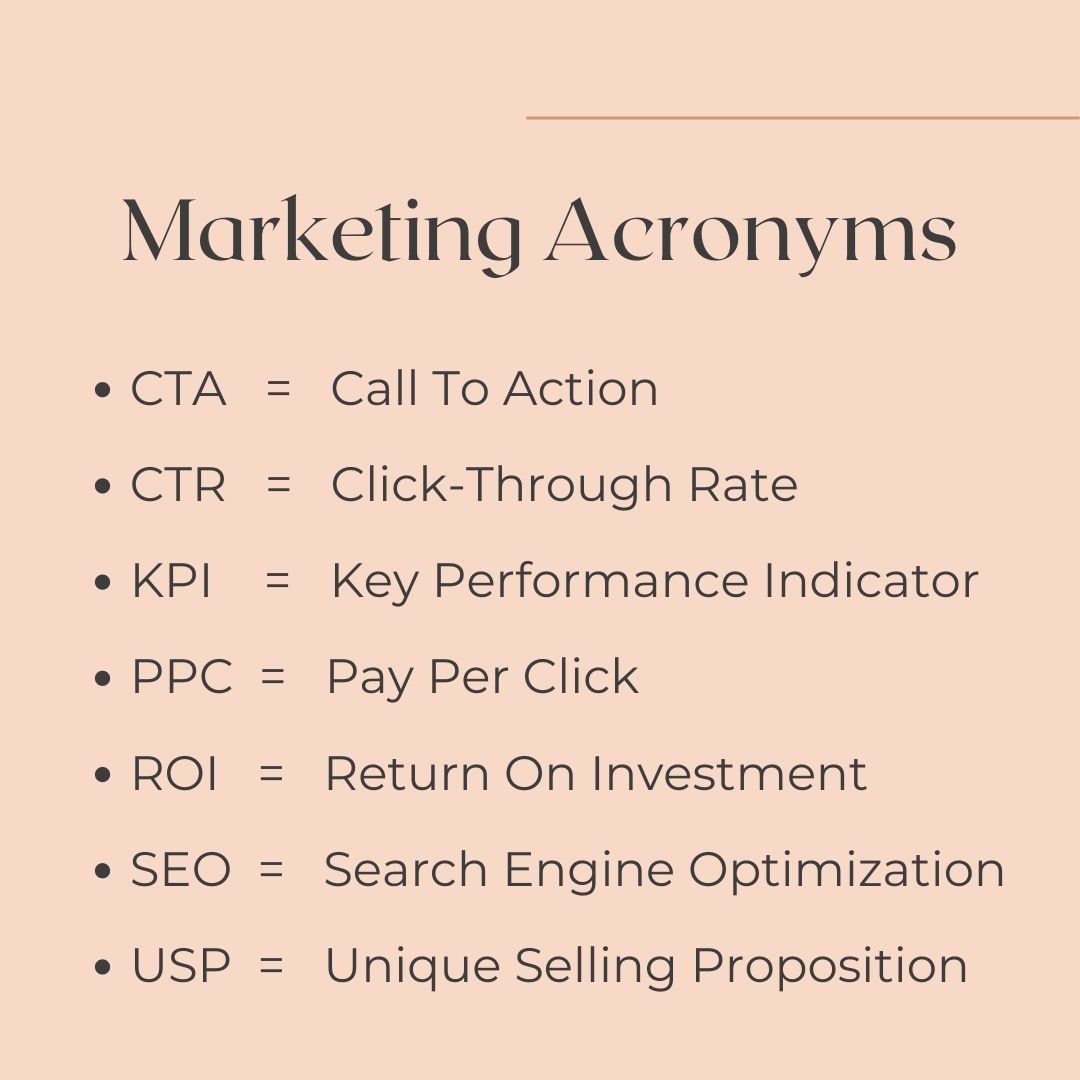
–CTA = Call To Action
A CTA is about prompting users/viewers to act in a specific way (encourages customers to buy the product, members to sign up for that newsletter, etc.)
–CTR = Click-Through-Rate: ratio of clicks to views.
CTRs help businesses determine the success of their online advertising. (Are people provoked to act (click on the link) or are they merely scrolling on?)
–KPI = Key Performance Indicator
A KPI is a set of measurements to assess the performance of an organization, company, etc. (Was my business’s goal achieved? Did I reach my target?)
-PPC = Pay Per Click
This one is just what it sounds – advertisers pay each time their ad is clicked. This is often used to generate traffic to websites.
-ROI = Return On Investment
ROI is utilized to discover the gains from your social media strategy. Was it worth the investment? Add the value gained and divide it by the investment made to determine your ROI.
-SEO = Search Engine Optimization
Simply put, SEO is the process in which you improve your visibility on search engines. This is done by optimizing the quality of your website and making the content easily discoverable. We wish it was only this simple. SEO can be a complicated beast & requires constant learning.
-USP = Unique Selling Proposition (also unique selling point)
What makes your business different from everyone else’s? What is it that only you offer?
Author: Kara Timberlake, Co-Creator of Envie Media
 Envie Media LLC